Quick Answer:
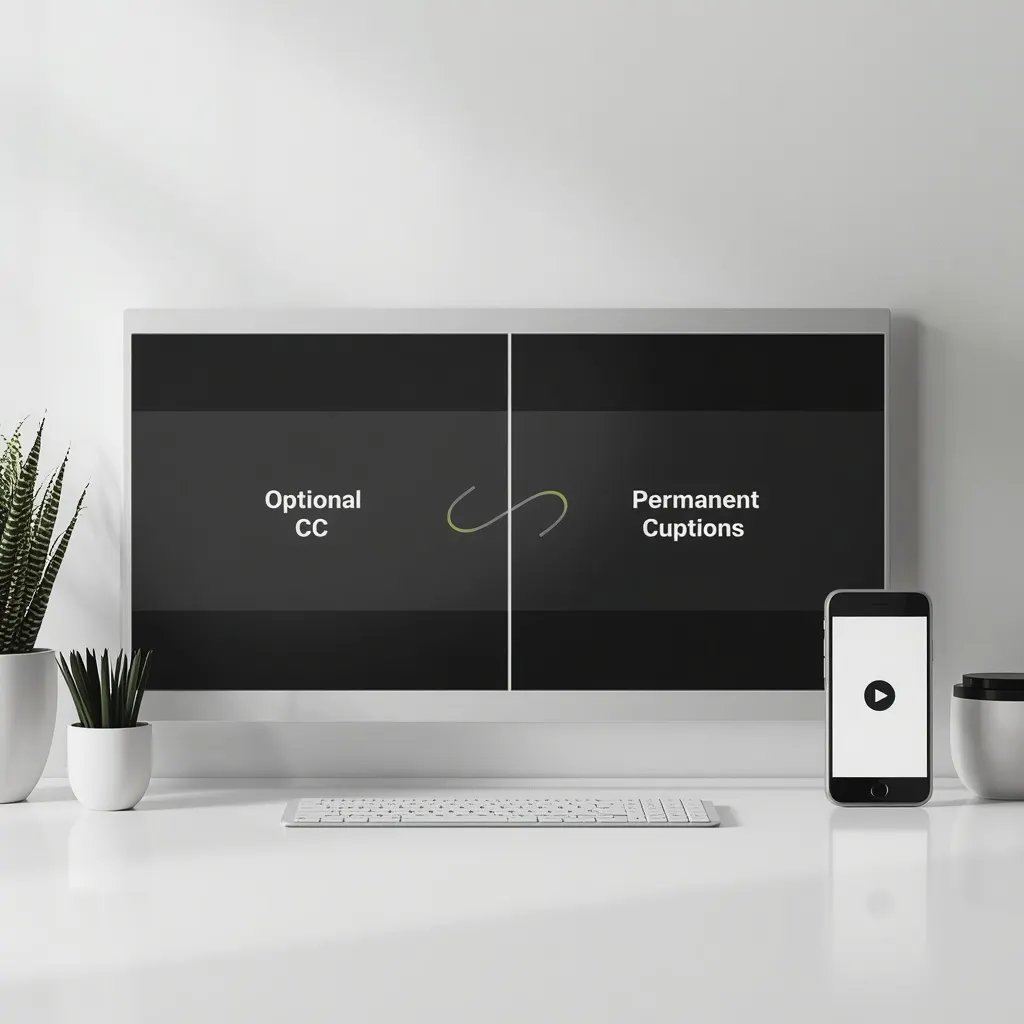
Closed captions are optional text tracks that viewers can turn on or off. They can include spoken dialogue, speaker identification, music, and important sound effects.Open captions are permanently displayed as part of the video. Viewers cannot switch them off because the text has been embedded directly into the video.
If you are comparing closed caption vs open caption, the main difference is simple. Closed captions can usually be turned on or off by the viewer, while open captions stay permanently visible on the video.
If you are searching for closed caption turn off, you normally need to open the video’s CC or captions control and switch it off. The exact steps depend on the platform, app, and device.
| Feature | Closed Captions | Open Captions |
|---|---|---|
| Can viewers turn them off? | Yes | No |
| Permanently part of video? | No | Yes |
| Viewer control | High | None |
| Can be edited separately? | Yes | Usually no |
| Works without caption support? | No | Yes |
| Useful for accessibility? | Yes | Yes |
| Customizable by viewer? | Often | No |
| Best for | Streaming and accessible players | Social videos and unsupported players |
The biggest difference is viewer control. Closed captions give people the choice to display text when they need it. Open captions guarantee that everyone sees the text.
What Are Closed Captions?
Closed captions are synchronized text that represents speech and other important audio information in a video. Viewers normally activate them through a CC button, captions menu, or accessibility setting.
They can help people who are Deaf or hard of hearing, but that is not their only benefit. Captions can also help people watching videos in noisy places, people who need to keep their device muted, and viewers who understand information better when they can read it.
Closed captions can include more than spoken words. Depending on the video, they may identify a speaker or describe meaningful sounds such as music, laughter, a phone ringing, or footsteps.
How closed captions work
A video player loads the caption information separately from the visible video. Caption files can use formats such as SRT or VTT.
Because the captions remain separate from the video, creators can often correct or update them without editing the entire video.
This also gives viewers more control over whether captions appear.
What Are Open Captions?
Open captions are permanently visible text that forms part of the video itself.
Because the captions are embedded into the video, viewers cannot remove them through the CC button or player settings.
Open captions can be useful when a platform does not support separate caption tracks or when the creator wants every viewer to see the text automatically.
Why creators use open captions
Open captions can work well when:
- The publishing platform does not support closed captions.
- The video will play without reliable caption controls.
- Every viewer needs to see the text.
- The video will appear on a display where sound may not be available.
- The creator wants complete control over caption placement and design.
Open captions can provide useful accessibility support, especially when closed captioning is not available.
Closed Caption vs Open Caption for Accessibility
Both caption types can make video content easier to understand, but they give viewers different levels of control.
Closed captions usually provide more flexibility because viewers can choose whether to display them. Some video players also let users change caption size, color, background, or other display settings.
Open captions remove that choice. Everyone sees the same text, and viewers cannot hide or customize it through the player.
That does not make open captions ineffective. They can still help viewers understand video content, especially when a platform does not offer reliable closed caption controls.
Why viewer control matters
Different viewers have different needs.
One viewer may need captions throughout the entire video. Another may only need them in a noisy environment. Someone else may prefer watching without any text on the screen.
Closed captions allow each viewer to make that choice.
For accessibility, this flexibility can create a better experience for a wider range of people.
Closed Caption Turn Off: How Do You Disable Them?
If you are searching for closed caption turn off instructions, start with the video’s CC button.
On many platforms, you can:
- Open the video.
- Tap or click the video player.
- Find the CC or captions icon.
- Select the icon to turn captions off.
- If captions return automatically, check the platform’s default caption settings.
The exact process varies between websites, apps, smart TVs, browsers, and mobile devices.
How to turn off captions on YouTube
YouTube provides a caption control directly within the video player.
On many devices, open the video and tap or click the CC button. If captions are currently active, selecting the button again will turn them off.
If captions keep returning, check your YouTube caption settings and your device accessibility settings.
Why Won’t Closed Captions Turn Off?
Sometimes captions remain visible even after you think you disabled them. Several situations can explain this.
The video has open captions
If the text is permanently embedded into the video, it is an open caption. You cannot remove it using the CC button.
Your default settings keep captions enabled
Some platforms and devices automatically display captions whenever they are available. Check your accessibility or caption settings if captions keep returning.
The platform uses another caption control
Some players place caption options inside a Settings menu instead of showing a separate CC button.
The text is part of the video
Creators sometimes add text while editing a video. This text may look exactly like a caption but is actually part of the video image.
A simple test can help:
If the text disappears when you disable CC, it is probably a closed caption track. If it stays visible, it may be open captions or text embedded into the video.
Closed Captions vs Subtitles
Closed captions and subtitles can look similar, but they often serve different purposes.
Captions generally provide spoken dialogue plus important audio information needed to understand the video.
Subtitles usually focus on spoken dialogue, particularly when the viewer needs a translation into another language.
For example:
- Caption: Door closes. Alex: I will call you tomorrow.
- Subtitle: I will call you tomorrow.
The caption provides additional information about the sound in the scene. The subtitle focuses mainly on the spoken words.
Some platforms and regions use the terms differently, so the exact meaning can depend on the context.
Closed Captions vs Transcripts
A transcript provides a written version of audio content, but it usually does not appear at the exact moment each word is spoken.
Closed captions are synchronized with the video. The text appears as the relevant dialogue or sound happens.
When to use closed captions
Use closed captions when:
- Viewers need text while watching.
- Timing matters.
- You want synchronized accessibility support.
- People may watch without sound.
When to use a transcript
Use a transcript when:
- Readers need to scan the complete content.
- You want a searchable text version.
- People need access to the information without watching the video.
- You want to provide a written alternative.
Providing both can make video content easier to access and navigate.
Which Is Better: Open or Closed Captions?
For most videos that support caption tracks, closed captions are more flexible because viewers can control whether they appear.
They can also provide customization options when the video player supports them.
Choose open captions when you need the text to remain visible or when your publishing environment does not support reliable closed caption tracks.
The right choice depends on your audience, platform, video format, and accessibility needs.
Choose closed captions if you want
- Viewer control
- Optional display
- Easier caption corrections
- Separate caption files
- Greater flexibility
- Customization when supported
Choose open captions if you need
- Captions visible to everyone
- No dependence on caption controls
- Captions on platforms without suitable CC support
- Consistent visual presentation
- Text permanently embedded into the video
Common Accessibility Mistakes With Captions
Adding captions is a good start, but caption quality also matters.
Relying only on automatic captions
Automatic captions can save time, but speech recognition can make mistakes.
Always review automatic captions when accuracy matters. Correct names, technical terms, unclear sentences, and missing words before publishing.
Leaving out important sounds
Captions should communicate meaningful audio information, not just spoken dialogue.
Important sounds, speaker changes, music, and other audio details can affect how someone understands a scene.
Covering important visual content
Open captions can cover faces, signs, diagrams, or other important visual information.
Place captions where they remain easy to read without blocking essential content.
Forgetting mobile viewers
Small screens make caption readability even more important.
Use clear text, good contrast, sensible line lengths, and enough screen space for viewers to follow the captions comfortably.
Assuming captions and subtitles are identical
Captions and subtitles can serve different audiences.
Think about what your viewers actually need before choosing the format.
How to Choose the Right Caption Type
Ask yourself these questions before publishing your video.
- Does the platform support closed caption tracks?
If yes, closed captions can give viewers more control. - Does every viewer need to see the text?
If yes, open captions may make more sense. - Could captions distract some viewers?
Closed captions let viewers hide them. - Will the video appear somewhere without reliable player controls?
Open captions may be more practical. - Will you need to correct the captions later?
Separate closed caption files can make editing easier. - Does accessibility matter for your audience?
Make sure your captions include the information viewers need to understand the video.
A Simple Example
Imagine a cooking video where a chef says, “Add the garlic now,” while a timer beeps in the background.
A useful caption could communicate:
- Chef: Add the garlic now.
- Timer beeps.
With closed captions, viewers can turn the text on or off.
With open captions, the text stays visible because it is part of the video.
The information can be similar, but the major difference is how viewers control the captions.
FAQs
Is closed caption the same as open caption?
No. Closed captions can normally be turned on or off by the viewer. Open captions remain permanently visible because they are embedded into the video.
Can you turn off open captions?
No. If the captions are genuinely open captions, they are part of the video image and cannot be disabled through the media player.
Can closed captions be turned off?
Yes. Closed captions are designed to give viewers the option to show or hide them. The exact control depends on the platform.
Are closed captions better for accessibility?
Closed captions often provide more flexibility because viewers can control their display. Open captions can still provide accessibility support when closed caption features are unavailable.
Do closed captions include sound effects?
They can. Good captions may include meaningful sounds, music information, speaker identification, and other audio details that help viewers understand the content.
What does CC mean on a video?
CC usually means closed captions. It indicates that a caption track is available and can generally be switched on or off.
Why do captions keep appearing after I turn them off?
Your platform or device may have captions enabled as a default accessibility setting. The video may also contain open captions that cannot be disabled.
Are subtitles and closed captions the same?
Not always. Closed captions generally communicate dialogue and important audio information, while subtitles often focus on spoken dialogue, especially when translating between languages.
Which caption type should I use for social media?
It depends on the platform. If the platform supports closed caption tracks, they provide more viewer control. If it does not, open captions can provide a practical alternative.
Can screen readers read open captions?
Open captions are embedded into the visual video and are not generally available as separate text to assistive technology. This makes the underlying accessibility structure important when creating video content.
conclusion
The closed caption vs open caption difference mainly comes down to viewer control.
Closed captions can usually be displayed or hidden by the viewer. Open captions remain permanently visible because they are part of the video itself.
If you are searching for closed caption turn off instructions, look for the CC or captions button first. If the text remains after you disable it, the video may contain open captions or text permanently embedded into the video.
For most accessible digital video, closed captions offer useful flexibility. Open captions still have an important role when captions need to remain visible or the platform does not support a suitable closed caption system.